
Professional certifications can open doors that a resume alone cannot. They prove your skills. They show employers that you are serious about your field. However, earning a certification does not happen by accident. It requires a clear plan and consistent effort.
A personal education plan helps you stay focused and organized. It maps out exactly what you need to learn and when. Additionally, it keeps you motivated during the long journey toward your certification goal. Whether you are pursuing your first certification or your fifth, a solid plan makes all the difference.
This guide will walk you through every step of building a personal education plan for professional certifications. Therefore, by the time you finish reading, you will know exactly where to start and how to move forward with confidence.
What Is a Personal Education Plan?
A personal education plan, often called a PEP, is a structured roadmap for your learning journey. It outlines your goals, the resources you will use, the timeline you will follow, and the milestones you want to reach. Think of it as a GPS for your professional development.
Unlike a general study schedule, a personal education plan is tailored specifically to you. It takes into account your current skill level, your available time, and your career objectives. Therefore, it is far more effective than simply signing up for a course and hoping for the best.
Many successful professionals use personal education plans to guide their growth. However, most people skip this step and jump straight into studying. As a result, they often feel overwhelmed, lose direction, and give up before reaching their goal. A well-crafted plan prevents this from happening.
Why Professional Certifications Matter
Before building your plan, it helps to understand why certifications are worth pursuing. Certifications validate your expertise in a specific area. They signal to employers and clients that you have met a recognized standard of knowledge and skill.
In many industries, certifications are not optional. Fields like information technology, project management, healthcare, finance, and cybersecurity often require or strongly prefer certified professionals. Additionally, certified workers frequently earn higher salaries than their non-certified peers.
Furthermore, certifications keep your skills current. Industries evolve quickly. A certification program forces you to learn the latest tools, methodologies, and best practices. Therefore, the time and effort you invest in a certification will pay dividends throughout your career.
Step 1: Define Your Career Goals Clearly
Every strong personal education plan starts with a clear goal. You need to know where you want to go before you can plan how to get there. Ask yourself what role you want to hold in the next one to three years. Consider what skills that role requires.
Be specific about your goal. Instead of saying you want to work in technology, identify the exact role and certification. For example, you might aim to become a certified project manager within 12 months. This kind of clarity gives your plan direction and purpose.
Additionally, think about whether your goal is short-term or long-term. Some certifications are entry-level and can be earned in a few weeks. Others are advanced and require months or even years of study. Knowing your timeline helps you build a realistic plan from the start.
Step 2: Research the Right Certification for You
Not all certifications are equal. Some are well-recognized across industries, while others are niche. Therefore, research is a critical part of building your education plan.
Start by identifying the top certifications in your field. Talk to professionals who already hold those certifications. Read job postings in your target role and note which credentials appear most often. This research will reveal which certifications employers actually value.
Once you have a shortlist, compare each option across several factors:
- The organization that issues the certification and its reputation in your industry.
- The prerequisites required before you can take the exam.
- The cost of study materials, training courses, and the exam itself.
- The renewal requirements and how often you must recertify.
- The time commitment typically needed to prepare and pass the exam.
After comparing these factors, choose the certification that best aligns with your goals and current situation. However, do not overthink this step. It is better to start working toward one certification than to spend months deciding between options.
Step 3: Assess Your Current Knowledge and Skills
Before you can build a study plan, you need to know where you currently stand. A self-assessment helps you identify your strengths and the gaps you need to fill.
Many certification programs provide an official exam outline or a list of competency areas. Use this document as a checklist. Go through each topic and rate your confidence level honestly. Mark areas where you feel strong and areas where you need significant work.
Additionally, look for free practice tests or sample questions online. These tools give you a realistic sense of your readiness. They show you which topics require the most attention. Therefore, your study time will be focused where it matters most rather than spread evenly across subjects you already know well.
Step 4: Set a Realistic Timeline
Time management is one of the biggest challenges in any self-directed learning journey. Setting a realistic timeline is essential. It prevents burnout and keeps you on track without creating unnecessary pressure.
Start by choosing a target exam date. Work backward from that date to create weekly study milestones. For example, if your exam is in six months, you might plan to cover one major topic area every three to four weeks.
However, be honest about how much time you can realistically commit each week. Consider your work schedule, family responsibilities, and personal commitments. Most people can manage five to ten hours of focused study per week alongside a full-time job. Build your timeline around what is actually achievable for you.
Furthermore, build buffer time into your schedule. Life is unpredictable. There will be weeks when studying is difficult. A buffer of two to three weeks before your exam date gives you room to catch up without panic.
Step 5: Choose Your Learning Resources
Once you know your timeline, it is time to select your study resources. The quality of your resources directly affects the quality of your preparation. Therefore, choose carefully.
Official Study Guides and Textbooks
Most certification bodies publish official study guides. These books are written specifically for the exam and cover all the required topics. They are often the best starting point for any certification preparation. However, they can be dense and technical. Plan to supplement them with other formats.
Online Courses and Video Platforms
Online learning platforms offer courses designed specifically for certification exams. Video instruction makes complex topics easier to understand. Additionally, many platforms allow you to learn at your own pace, which works well for busy professionals. Look for courses with high ratings and recent reviews to ensure the content is up to date.
Practice Exams and Flashcards
Practice exams are one of the most valuable tools for certification preparation. They simulate the real test environment and help you identify weak areas. Additionally, flashcards are excellent for memorizing key terms, formulas, and concepts. Use both consistently throughout your preparation.
Study Groups and Online Communities
Studying with others can accelerate your learning. Many certification candidates form study groups to share notes, discuss difficult concepts, and keep each other accountable. Online forums and communities dedicated to specific certifications are also highly active and helpful. Therefore, do not overlook the value of peer learning.
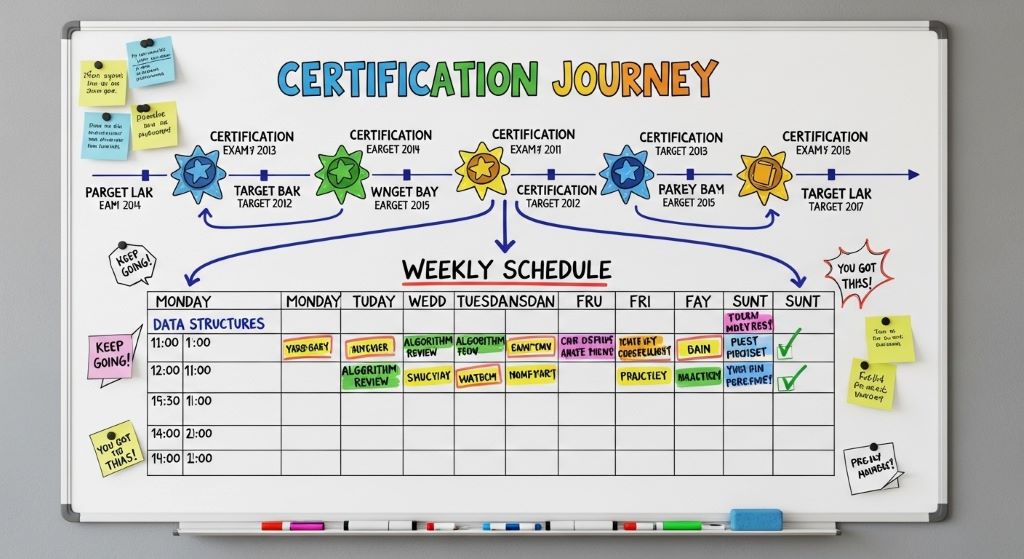
Step 6: Create a Weekly Study Schedule
A timeline tells you when to reach certain milestones. A weekly study schedule tells you exactly how to get there. These two tools work together to keep your plan on track.
Break your study sessions into blocks of 45 to 90 minutes. Research shows that focused sessions of this length are more productive than marathon study sessions. Additionally, shorter sessions are easier to fit into a busy day.
Assign specific topics to specific days. For example, you might dedicate Mondays to reading your study guide, Wednesdays to watching video lessons, and Saturdays to completing practice questions. This structure removes the daily decision of what to study and lets you get straight to work.
Furthermore, schedule your study sessions at a consistent time each day. Consistency builds habit. Over time, studying becomes automatic rather than something you have to force yourself to do.
Step 7: Track Your Progress and Adjust
Building a plan is only half the work. You also need to track your progress and adjust as needed. Without tracking, it is easy to fall behind without realizing it until it is too late.
Review your plan at the end of each week. Ask yourself whether you completed your planned study sessions. Note which topics felt difficult and which felt manageable. If you are consistently falling behind, adjust your timeline or reduce the scope of weekly goals.
Additionally, retake practice exams regularly. Compare your scores over time. If your scores are improving steadily, your plan is working. If they are plateauing, it may be time to change your study approach or seek additional resources.
However, do not be too hard on yourself when you miss a session or have a difficult week. Setbacks are normal. What matters is that you return to your plan quickly and keep moving forward.
Step 8: Prepare for Exam Day
All of your planning and studying leads to one moment: the exam. Preparing for exam day is a critical and often underestimated part of the process.
In the final two weeks before your exam, shift your focus from learning new content to reviewing what you already know. Take full-length practice exams under realistic conditions. Time yourself. Simulate the pressure of the real test.
Additionally, take care of your physical health during this period. Sleep is critical for memory and focus. Aim for seven to eight hours of sleep each night. Eat well and stay hydrated. Exercise regularly to reduce stress and improve concentration.
On the day of the exam, arrive early. Bring all required identification and materials. Take a few deep breaths before you begin. Trust the preparation you have done. You have built a solid plan and followed it. Therefore, you are more ready than you think.
Staying Motivated Throughout the Journey
One of the hardest parts of any long-term study plan is staying motivated. The initial excitement often fades after a few weeks. Therefore, building motivation strategies into your education plan is just as important as scheduling study sessions.
Celebrate small wins. Each time you complete a chapter, pass a practice test, or master a difficult concept, acknowledge the achievement. These small victories build momentum and remind you that progress is happening.
Additionally, keep your end goal visible. Some people post their certification goal on their desk or set it as their phone wallpaper. This simple reminder keeps the bigger picture in focus during difficult weeks.
Furthermore, connect with others who are on a similar journey. Sharing challenges and successes with peers creates a sense of community and shared purpose. This connection is a powerful source of ongoing motivation.
Conclusion
Building a personal education plan for professional certifications is one of the smartest investments you can make in your career. It transforms a vague ambition into a clear and actionable path. Every step in this guide plays a role in your success.
Start by defining your career goals and choosing the right certification. Then assess your current knowledge and set a realistic timeline. Select the best learning resources, create a weekly study schedule, and track your progress consistently. Finally, prepare thoroughly for exam day and keep your motivation strong throughout the journey.
Additionally, remember that a personal education plan is a living document. It can and should be adjusted as your circumstances change. What matters most is that you start. Take the first step today, and every step after that becomes easier. Your certification goal is within reach, and a strong education plan is the key to getting there.
Frequently Asked Questions
1. How long does it take to build a personal education plan?
Building a personal education plan does not have to take long. Most people can create a solid first draft in two to three hours. Start by setting your goal and choosing your certification. Then map out a timeline and list your resources. You can always refine the plan as you go. However, having even a basic plan in place is far better than starting without one.
2. Can I follow a personal education plan while working full time?
Yes, absolutely. In fact, most people who pursue professional certifications do so while working full time. The key is to be realistic about how much time you can commit each week. Even five to seven hours of focused study per week can lead to significant progress over several months. Therefore, building a schedule that fits your life is essential to staying consistent without burning out.
3. What should I do if I fall behind on my education plan?
Falling behind is common and does not mean your plan has failed. The most important thing is to reassess rather than give up. Review your timeline and adjust your exam date if necessary. Reduce the weekly study load to a level you can actually sustain. Additionally, identify what caused the delay and address it directly. Flexibility is a built-in feature of any good personal education plan.
4. How many certifications should I include in one education plan?
For most people, focusing on one certification at a time is the most effective approach. Splitting your attention across multiple certifications can dilute your focus and slow your overall progress. However, once you have earned one certification, you can immediately begin planning for the next. Over time, a series of certifications builds a powerful and credible professional profile.
5. Are free study resources good enough to pass a certification exam?
Free resources can be very helpful, especially for supplementing paid materials. Many high-quality study guides, practice questions, and video lessons are available at no cost. However, for most certification exams, investing in at least one official study guide or a reputable paid course is worth it. The exam itself represents a significant investment of time and money, so quality preparation materials are a smart use of your resources.
Related Topics:
Public Speaking Tips for Students: Authentic Confidence
What is the Feynman technique for learning complex subjects?